
Where Do AFL Fans Live in Melbourne Today?
Victoria is home to 10 of the 18 AFL teams. Most were founded in the 1800s, long before the national competition began in 1987. The newest Victorian club entered the VFL competition in 1925. No new Victorian team has been added in 100 years.
In that same century, Melbourne has transformed.
In 1925, the city’s population sat at just under one million. In 2025, it’s around 5.4 million. Growth has surged across the outer west and north. Inner suburbs have changed too. Former working class neighbourhoods have been redeveloped, renovated and, in many cases, priced beyond the reach of the communities that once defined them.
So what does that mean for AFL supporter geography?
Do fans still live near the suburbs their clubs are named after? Or has urban growth and gentrification reshaped Melbourne’s traditional football boundaries?
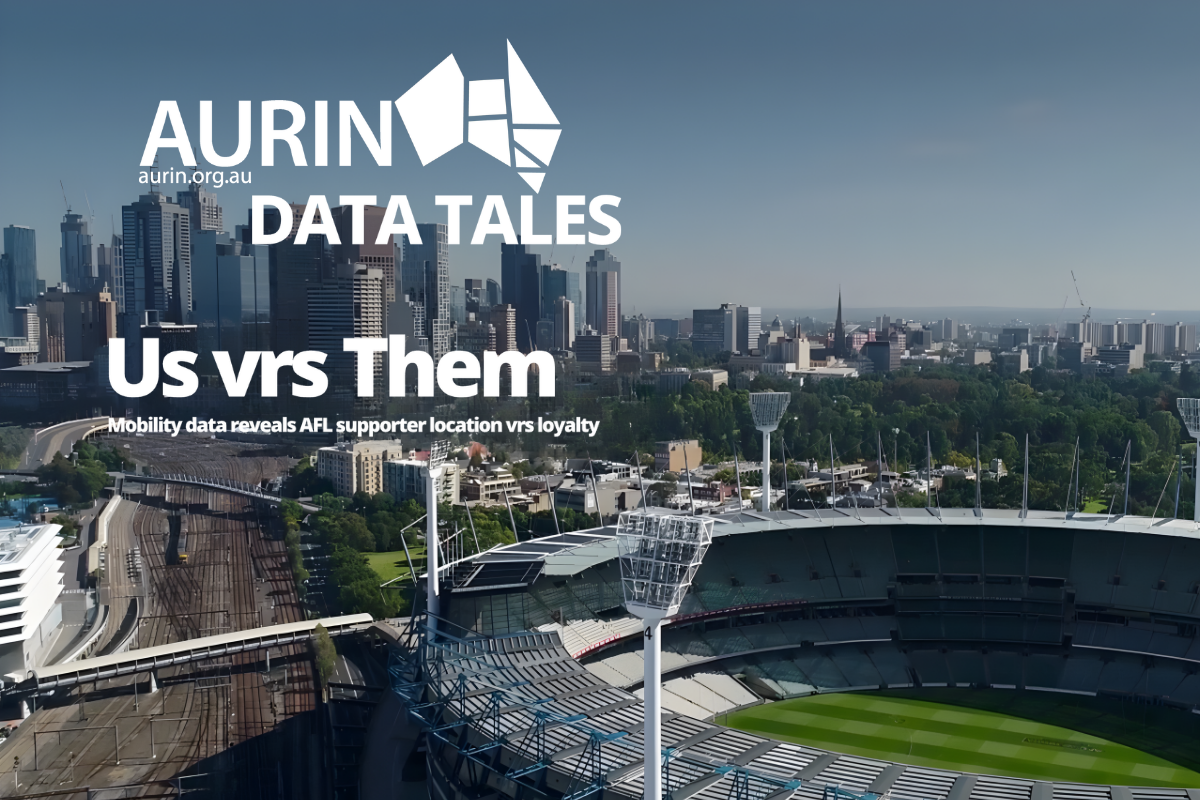
A new AURIN Data Tale, Us vs Them, uses human mobility data to find out.

Mapping AFL Supporters Using Mobility Data
There is no public dataset that shows where AFL supporters live. Surveys are costly and limited. Membership data is private and excludes non members.
Instead, this project uses anonymised human mobility data from DSpark.
When mobile phones connect to the network, they leave a spatial signal. Using privacy protected, aggregated data, it’s possible to infer where people live and move, without identifying individuals. Strict safeguards apply. To explore the geographic spread of AFL fans we analysed matches at the Melbourne Cricket Ground, Marvel Stadium and GMHBA Stadium.
We mapped the average home location of attendees by SA2. What we’re measuring is not every supporter, but people who attend games, a strong proxy for the active supporter base.
What the Maps Show
The results are clear and, in some cases, surprising. Clubs that still reflect their suburb include Essendon, the Western Bulldogs, Hawthorn, Richmond and Geelong where supporters mostly live in or near their traditional heartlands.
Essendon fans cluster around Moonee Ponds, Ascot Vale and surrounding north west suburbs. Bulldogs fans are firmly anchored in Melbourne’s west. Geelong supporters overwhelmingly live across the broader Geelong region.
For these clubs, geography still matters.
Clubs that have shifted include Carlton and Collingwood. Despite being named after inner city suburbs close to the CBD, their supporters are spread widely across Greater Melbourne. Strong clusters appear in outer northern and western suburbs, well beyond their original boundaries.
Why?
The maps suggest gentrification may be part of the answer.
Carlton, once a working class stronghold, has experienced significant property value growth since the 1980s. Its demographic profile has shifted toward professionals and students. If AFL supporter bases historically skew working class, it makes sense that supporters would relocate to more affordable suburbs as housing prices rise.
In contrast, Essendon, further from the CBD, remains comparatively accessible. Its supporter base still centres on its traditional location.
Mobility data alone cannot prove the drivers behind these patterns. But it highlights where deeper analysis is needed.
Why This Matters for Urban Research
This Data Tale highlights broader urban accessibility and socio-economic shifts of the population. It shows how mobility data can reveal how people interact with cities. When combined with housing affordability, income and demographic datasets available through AURIN’s data provider, researchers can explore questions such as:
- How does gentrification reshape cultural identity?
- Are public transport networks aligned with major event demand?
- Do fans head straight home after games, or cluster in entertainment precincts?
- How do different socio-economic groups move through the city?
AFL supporter geography becomes a lens into broader urban change.
Explore the Interactive Map
The full interactive map allows you to:
- View supporter distributions for all 10 Victorian AFL teams
- Identify the strongest supporter suburbs for each club
- Compare traditional club locations with current supporter patterns
It’s a practical demonstration of how hard to-get mobility data can unlock new insights into Melbourne’s urban evolution.
If you work in urban planning, transport, housing, social research or data science, this is a clear example of what’s possible when rich datasets are brought together in one place.
Explore the AURIN Data Tale and see where your club’s supporters really live.
ACCESS HARD TO GET DATA FOR AUSTRALIAN URBAN RESEARCHERS
AURIN has secured access to national level mobility data from DSpark for researchers, industry and decision-makers.
This data includes attributes such as Discreet Visit, Staypoint, Origin-Destination Matrix and Origin-Destination.
DSpark Mobility Data supports research to understand when, why and how people move. DSpark are leaders in processing large geospatial, temporal mobility data to deliver intelligence on people and places using the highest data privacy standards.
Understanding how people move, where they go and what they do enables organisations to map their strategy around where people live, work, and play.T hey can gain insights across human mobility, urban planning, transport, socioeconomics, epidemiology/public health, housing, and disaster management and produce outcomes that address national challenges such as climate change, energy transition and demographic transformation.
What is an AURIN Data Tale?
AURIN Data Tales are a series of interactive story telling maps to highlight the data access and analytics capability we offer and provide real-world examples of urban challenges, presented in an engaging way to inspire further research and data driven decision-making. We translate complex findings that can lead to impactful changes for Australia.