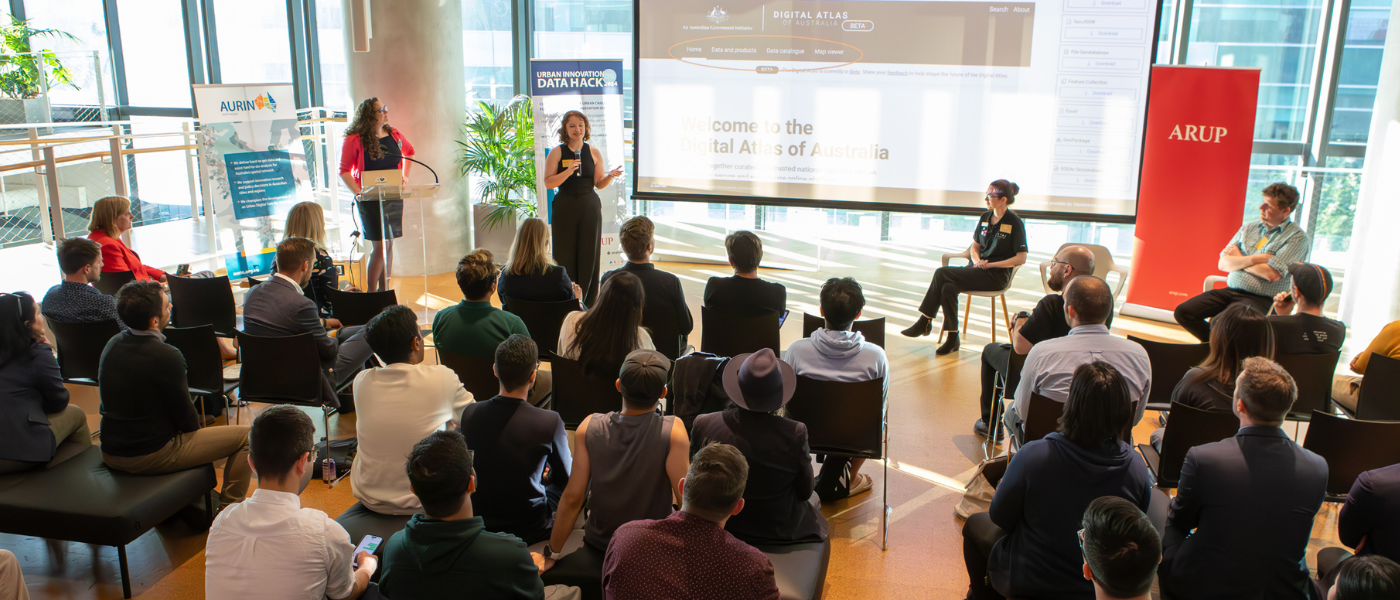
In partnership with Arup, we were thrilled to host the Urban Innovation Data Hack across 22 and 23 March 2024.
The hack presented an opportunity for developers, planners and others to come together to solve problems, showcase data and harness opportunities for Melbourne Innovation Districts (MID). MID is a partnership between the City of Melbourne, RMIT University and the University of Melbourne, developing urban innovations in Melbourne for the benefit of the whole city.
Competitors were given access to real-world urban data sets, sensor networks and simulation tools to solve challenges. Friday night featured presentations on data and tools from a variety of partners, including the Australian Bureau of Statistics, RMIT University, the Victorian Government Department of Transport and Planning, Eratos, Geoscience Australia, Google, ARDC and FrontierSI.
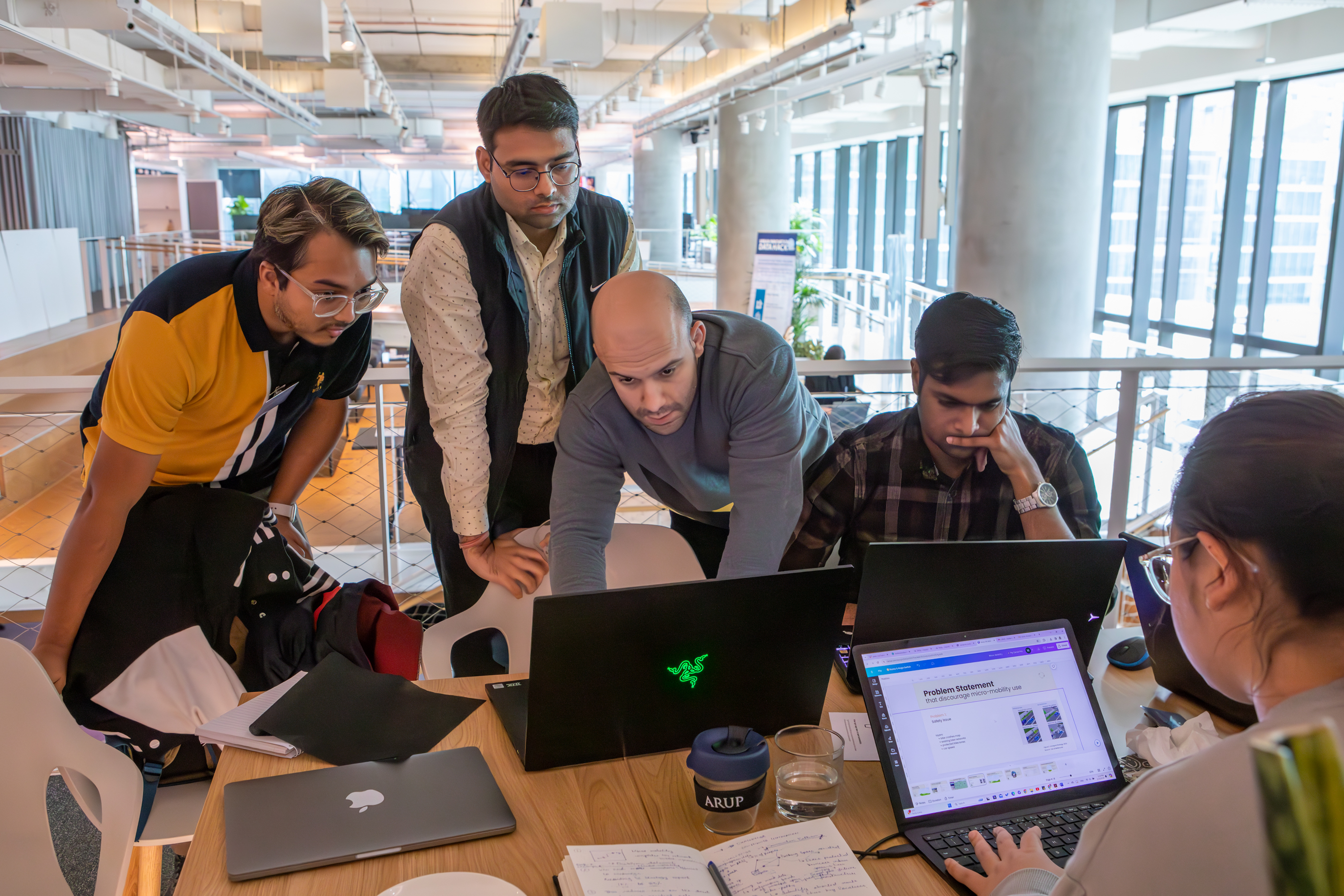
On Saturday, participants got to work with their teams developing projects addressing one of the hack’s four challenges: The 20-Minute Innovation District; Turning Down the Heat for Cool Innovation; Innovation for Renewable Cities; and A People-Centric Innovation District. Mentors from AURIN, Arup and partner organisations were available to help groups across data, tools, analytics, visualisations and presentations.
In the evening, groups presented their projects to a panel of judges from academia, government and industry: Pascal Perez (AURIN); Jago Dodson (RMIT); Kate Williams (FrontierSI); Julian Szafraniec (SGS Economics & Planning); and Odette Young (Eratos).
The winning team was ‘Team GKL’, who won for their project ‘ChargeQuest: Mapping the Future of Electric Vehicle Charging in MID’.
Based on existing data, Team GKL established that there was long-term demand for on-street EV charging stations in MID, and developed a roll-out strategy for the provision of on-street parking bays with these charging points.

The runners up were ‘Happy Hackers’ with their project, ‘Assessing and Enhancing the 20-Minute Innovation District: A Case Study of the Melbourne Innovation District’. This project focused on evaluating the MID’s current performance in fostering innovation and economic growth, with a particular interest in analysing accessibility of services within a 20-minute radius, including service access, population dynamics, commuting patterns, social structures, and district vibrancy.
In third place were ‘Team SGS’, with ‘City Fabric as Knowledge Production Space’. This included the development of a tool intended to assist the MID partnership in planning and promoting MID, both through monitoring outcomes and aiding in negotiations with target industries, businesses and institutions, and in maximising the effectiveness of programs and events.
These teams were rewarded with cash prizes from AURIN, AWS credits from Eratos and mentoring programs from Arup. The winning projects will also be presented to an audience of researchers, planners and decision-makers for the Melbourne Innovation District in order to seek further opportunities for development and impact.
It was incredible to see the range of high-quality projects developed in such a short space of time, with other groups focused on questions such as heat reduction, micro-mobility, quantifying innovation, green trails and more.
Thanks so much to all the participants, partners and supporters who made the Data Hack such a success!
All photos courtesy of Patrick Saggers, Flick Visual. Video courtesy of Dean Morris, Arup.