
The carbon emissions created by road-based transport are immense. Car and van transport account for 10% of global greenhouse gas emissions due to their use of fossil fuels. In Australia, which has some of the most car-dependent cities in the world, the carbon footprint of road-based transport is cause for concern. Over 20 million motor vehicles were registered in Australia in 2021, with over 98 per cent of these powered by fossil fuels.
To reduce climate harm and increase energy security at both urban and national levels, it is imperative to decarbonise motor vehicles. While many countries are encouraging a transition to electric vehicles (EVs) and a phase-out of fossil-fuel transport, Australia remains an outlier in EV policy, operating without an electric vehicle target or a statutory regime for vehicle emissions standards. This impacts EV adoption and inhibits an understanding of how governments and policymakers can curb carbon emissions with policies that support a fair transition to electric vehicles.
To tackle this issue, Tiebei Li and Jago Dodson from the Centre for Urban Research at RMIT University, Melbourne, undertook a study titled, “The Early-Phase Electric Vehicle Transition in an Australian City: Emerging Policy, Uptake Trajectories and Socio-Spatial Distribution in Melbourne.” This research conducted a socio-spatial analysis of electric vehicle uptake in Melbourne to investigate and understand the factors that are driving or inhibiting EV adoption.
Li and Dodson aimed to provide a greater understanding of where EV vehicles are being adopted in Australia’s metropolitan, sub-metropolitan, and suburban areas, and to analyse the socio-economic and geographical characteristics of EV buyers to identify inequities in subsidy schemes or other factors affecting EV transition.
Their research analysed motor vehicle registration datasets to identify the number and distribution of EVs in suburban areas. This information was then aligned with socio-economic data from ABS Census and data on housing and energy infrastructure, accessed through AURIN. AURIN’s datasets on dwelling and energy access, car ownership, access to public EV charging stations, and household residential solar installation, were effectively used in the research to investigate how local contextual factors can impact EV adoption.
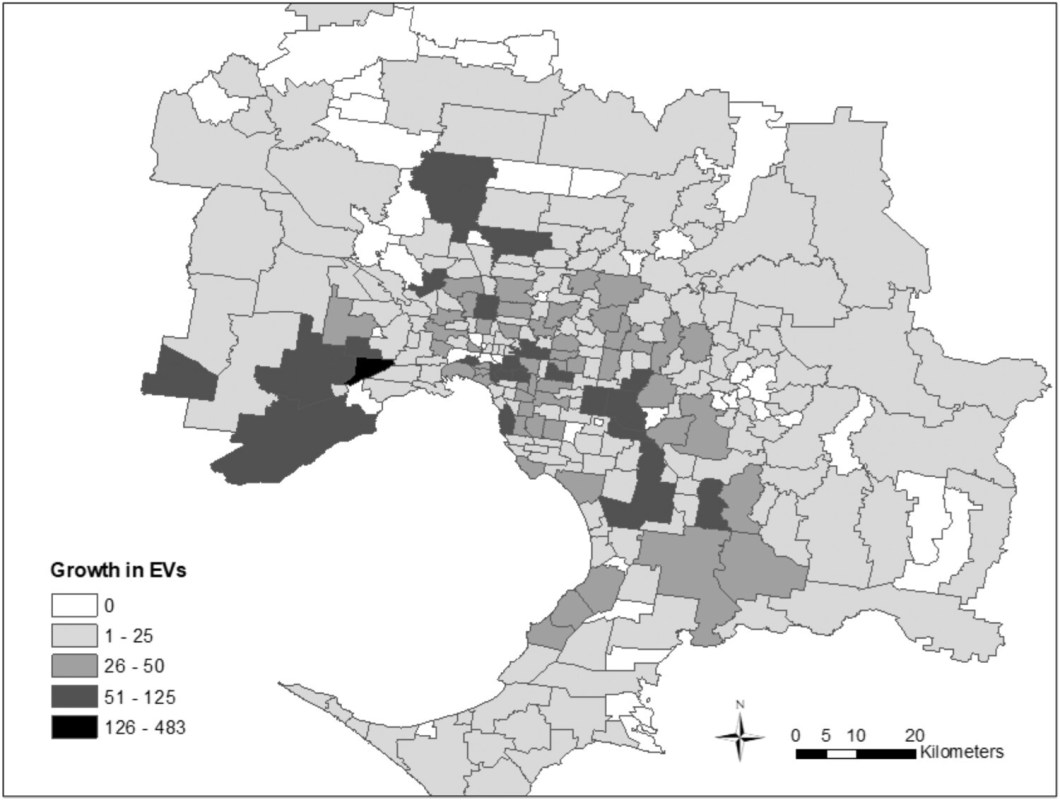
Li and Dodson’s study revealed that EV uptake is influenced by socio-economic factors. Postcodes with high household income, high home ownership or a high proportion of daily travel by car experienced higher growth in EVs than areas with lower scores on these factors.
They also found that EVs are more popular in middle- and outer-suburban locations where levels of car use and rates of car ownership are high compared to more central localities. This is expected to grow, as EV uptake appears to be dispersing across rather than concentrating within postcodes. It is projected that EV growth will be strongest in outer-suburban areas, particularly to the west, north and south east of Melbourne by 2030.
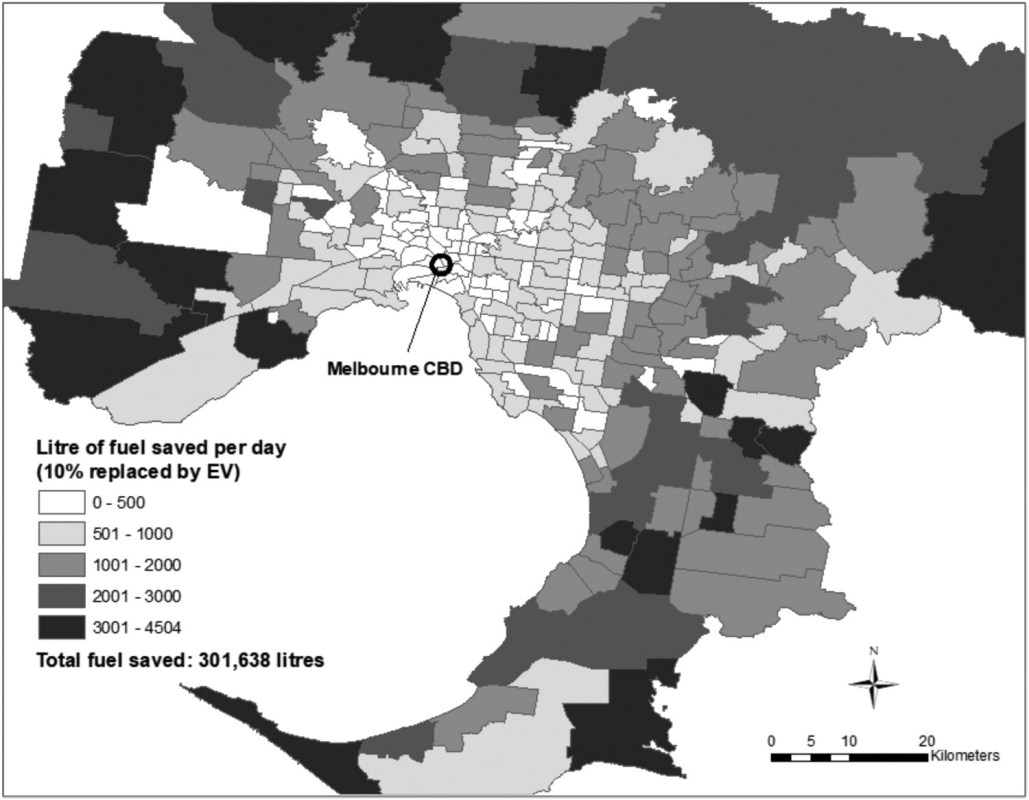
Another important finding from the study was the potential carbon savings of greater EV adoption in Australia. Li and Dodson calculated that a transition to 10% EVs on Australian roads would equate to 693.8 tonnes of carbon emissions savings per day. The researchers also calculated a commuting fuel cost reduction of approximately $500,000 per day, based on fuel prices at time of writing. This equates to approximately $200m annual fuel savings for commuting journeys alone.
While it is an early investigation into an emergent topic, this paper is essential in providing a useful baseline for future investigations of spatial EV adoption. Without this spatial and socio-economic research, a transition to EV vehicles and phase out of fossil-fuel vehicles will be more challenging, time-consuming, and at greater risk of inequity. Given the worsening climate crisis and the potential carbon savings of even a 10% EV transition, it is imperative for Australian policy at every governmental level to prioritise sustainable EV uptake across communities.
This is a particularly important study for AURIN as we are funding The Green Australian Vehicle Ownership (GreenAVO) Capability – a project that collates motor vehicle registration and environmental efficiency data to provide an ongoing dataset through which to better track EV adoption at national, state, metropolitan and suburban scales. This significant cross-sectional database advances AURIN’s capability to deliver up-to-date vehicle ownership data for observing temporal trends and spatial patterns in changes to vehicle technologies and infrastructure requirements and thus fill the research gap when it comes to EV transition in Australia. More than this, it can help inform policy and subsidy schemes to better serve equitable and rapid EV transition.
AURIN was delighted to be a part of this research and looks forward to seeing further studies that can encourage sustainable travel in the future.